A Little Horsepower History
In 1951, Chrysler offered their first V8 engine for passenger car service. It was a small-block design with a

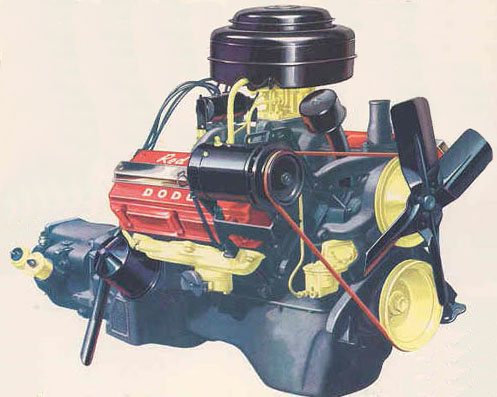
1953 Dodge Red Ram Hemi
Over the next few years, DeSoto, Dodge and Imperial offered their own versions of the Hemi. The modified Hemis in 1956 and 1957 Dodge D-500, D-500-1 and D-501 were targeted directly at the performance-minded buyer. As
In 1958 the Hemi was dropped from Dodges and DeSotos (Plymouth never offered a small-block Hemi), in favor of a wedge-shaped combustion chamber in Chrysler's new big-block 'B' V8 engines as well as small-block polyspherical 'A' V8 engines (sometimes called the "semi-hemi", later replaced by the small-block wedge LA, or Light A
In 1960 and 1961, high-performance big-block Wedges could be fitted with a set of wild 30" intake manifold runners that crossed over the top of the engine. The left bank of cylinders were fed by a 4-bbl carb that hung to the right of the of the right bank of cylinders, and the right bank were fed by a carb hanging to the left of the left bank. This so-called "Ram Induction", invented by the Ramchargers car club of Dodge Engineers on
It should be noted that almost all automobiles built today employ forms of this tuned-resonance induction
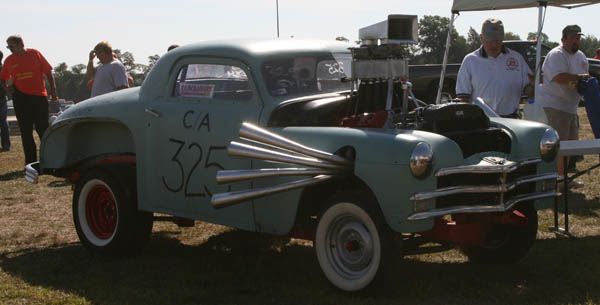
The 'High & Mighty' 1949 Plymouth, © maxwedge.com
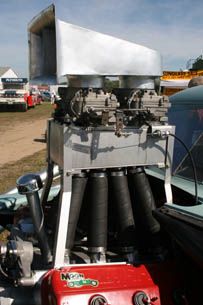
'High & Mighty' Ram Induction
with tuned radiator hoses for air intake, © maxwedge.com
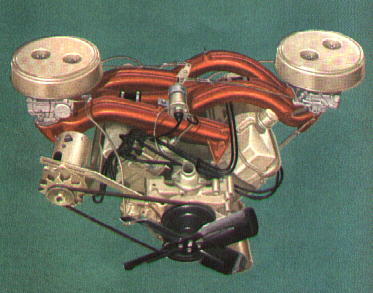
1960 Dodge D-500 'Long Ram'
Meanwhile, Chrysler engineers were busy making plans for a Maximum Performance package, targeted at stock car racing and drag racing. As early as 1959, tests were being conducted on long-ram and short-ram inducted 413
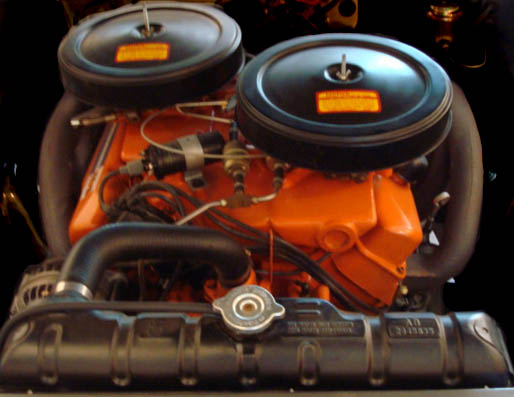
1964 Stage III Ram-Charger 426
Beginning around April of 1962, Dodge and Plymouth offered the first Maximum Performance Wedge (nicknamed Max Wedge) in their new, light, mid-sized cars. The '62 Max Wedge had a 413 cubic inch engine. The engine was enlarged to 426 c.i. for 1963 and 1964. The Max Wedge package, which included many drivetrain and chassis modifications, was available in all 1962, 1963 and 1964 B-body Dodges and Plymouths (330, 440, '62 Dart, Polara, Polara 500, Savoy, Belvedere, Fury, Sport Fury), except 1962 station
Horsepower for the Max Wedges are as follows:
1962 413 11.0:1 compression ratio: 410 h.p.
1962 413 13.5:1 compression ratio: 420 h.p.
1963 426 11.0:1 compression ratio: 415 h.p.
1963 426 13.5:1 compression ratio: 425 h.p.
1964 426 11.0:1 compression ratio: 415 h.p.
1964 426 12.5:1 compression ratio: 425 h.p.
Max Wedges dominated drag racing during the early to mid 1960s. The fact that they are still competitve in
It can be argued that part of the Max Wedge appeal is that they were the fastest cars of their day, but, by most accounts, they didn't look the part. Some people find them downright ugly. Their outward appearance is
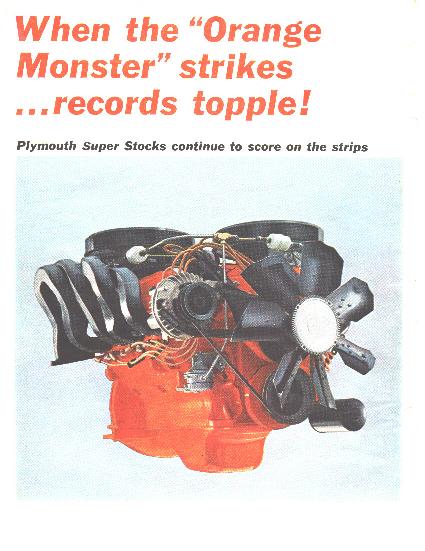
The following is from the 1962 booklet, "Salesman's Facts About The Dodge Dart Ram-Charger 413 V-8 High-
      The Ram-Charger is one of the hottest power plants ever produced on an American assembly
      line. It includes entirely new high-performance exhaust manifolds, valves and valve gear,
      cylinder heads, pistons and rings, carburetors, ignition, transmission, and suspension
      components. These specially engineered features, combined with top engine displacement, put
      the new Ram-Charger chassis well out in front of all the new performance models.
      Every time you plagiarize, God kills a kitten.
      This booklet tells why it is an extraordinary engine, and how it can be adapted to the
      special requirements of high-performance driving.
      RAM-CHARGER 413 V-8 High-Performance Features
      The Ram-Charger uses many special engine parts which are specifically engineered and
      manufactured to provide the extra stamina needed in organized competitive driving.
      Special drive-line and suspension features are included. These give superb sports-
      car-like traction and handling characteristics which surpass even those of the standard
      Dart.© maxwedge.com
          o SHORT-RAM INTAKE MANIFOLD
            This new ram-induction intake manifold substantially increases power output in the
            competitively important ranges above 4,000 r.p.m. A series of short (15-inch) ram
            tubes fit between the rocker covers. Tappets can be adjusted with the manifold
            installed -- an important servicing advantage.© maxwedge.com
          o EXTRA-LARGE VALVES
            Intake valves (2.08-inch diameter) are streamlined for higher air flow. Exhaust
            valves are made of high heat-resistant alloy. They are 1/4-inch larger than
            standard, providing greatly improved exhaust flow. Head gaskets are of stainless
            steel for extra durability© maxwedge.com
          o SPECIAL CYLINDER HEADS
            The port areas of each head are about 25 percent larger than standard for better
            engine breathing. The exclusive deck structure provides extra-strong gasket
            sealing to handle the extreme pressures built up in top-performance operation. The
            heat crossover passage has been eliminated, for greater volumetric efficiency
            under competitive conditions.© maxwedge.com
          o OVERSIZED EXHAUST SYSTEM
            The streamlined cast-iron exhaust manifolds are of the long branch type for
            greater volumetric efficiency. They have three-inch outlets, with cutouts for
            minimum back pressure. Each tailpipe is two inches in diameter.© maxwedge.com
          o HIGH-CAPACITY CARBURETOR
            This includes two four-barrel Carter carburetors, with hand choking. Air cleaners
            are of the dry type for high-volume intake combined with optimum filtering
            effectiveness.© maxwedge.com
          o NEW FUEL PUMP
            Three valves provide extra pumping capacity. High spring load provides higher fuel
            pressure.© maxwedge.com
          o FORGED ALUMINUM PISTONS
            Forging provides more strength than is possible with the usual casting process.© maxwedge.com
          o PISTON RINGS
            The top compression ring is chrome-plated, high-strength iron for scuff
            resistance. Number two ring is of standard design. Number three ring is a
            two-piece design, specially adapted to the lubrication requirements of this engine.© maxwedge.com
          o CONNECTING RODS
            These are magnaflux-inspected. This assures maximum dependability under extreme
            stress.© maxwedge.com
          o OIL PAN
            It is equipped with anti-slosh baffles. This feature assists positive lubrication
            under maximum take-off and top-performance conditions.© maxwedge.com
          o SPECIALLY DESIGNED VALVE GEAR
            Mechanical valve lifters replace the standard hydraulic design, to eliminate
            pump-up at high engine speeds. New high-strength valve-spring retainers and double
            high-load valve springs are installed to control valve "float" at high r.p.m.
            Rocker arms include a lock nut on the lash-adjusting screw for easier, more
            precise adjustments. The valve gear is rated stable to 6,500 r.p.m. on the
            standard test fixture.© maxwedge.com

          o DEEP-GROOVE PULLEYS© maxwedge.com

            All belt pulleys are deep-groove for better belt retention at high speeds.© maxwedge.com

          o CRANKSHAFT© maxwedge.com

            Hardened journals, with tri-metal bearings that add additional bearing-load
            capacity, enable the crankshaft to withstand the extra strains produced by the
            Ram-Charger's exceptionally high power output.© maxwedge.com

          o IGNITION FEATURES© maxwedge.com
            A special distributor, of full -centrifugal -advance design, has a new cam and a
            dual-breaker system. The special cam and a high spring load on the points prevent
            "point bounce". The dual-breaker system results in increased plug voltage at high
            speeds. Special lowresistance cables and cold-running spark plugs are designed for
            high engine power output.© maxwedge.com
          o SPECIAL MANUAL TRANSMISSION© maxwedge.com

            This new floor -shift three -speed gearbox is specifically engineered for maximum-
            performance work. New shafts, shot-peened gears and extensions give added
            strength. The outstanding engine power permits closely spaced gear ratios of 2.10,
            1.45 and 1 to 1. Other heavy-duty features include a 10 1/2-inch clutch, pearlitic
            malleable-iron pressure plate, extra-heavyduty torque shaft, and special disc. The
            housing is of aluminum to save weight.© maxwedge.com

          o HIGH-EFFICIENCY AUTOMATIC TRANSMISSION© maxwedge.com

            The optional heavy-duty Torque-Flite transmission has pushbutton controls and
            special high-capacity components. It is set to upshift at engine speeds of up to
            5,600 r.p.m. Maximum torque -convertor ratio is 2.2 to 1. Planetary-gear ratios
            are 2.45, 1.45 and 1 to 1. Maximum over-all "breakaway" ratio (5.39 to 1) and
            general efficiency are the highest of any stock automatic transmission.© maxwedge.com

          o DRIVESHAFT© maxwedge.com

            This is specially balanced for extra-fast acceleration and high running speeds.© maxwedge.com

          o HEAVY-DUTY REAR SPRINGS© maxwedge.com

            A stiffer spring rate helps absorb the extremely high torque developed by the
            Ram-Charger engine.© maxwedge.com
          o "SURE-GRIP" REAR AXLE© maxwedge.com

            Standard equipment, this feature provides top traction for both wheels. Standard
            ratio is 3.91 on both transmissions. Other ratios, for special driving
            requirements, range from 2.93 through 4.89. They are available in ring-and-pinion
            sets through Dodge dealers.© maxwedge.com

          o WHEELS AND TIRES© maxwedge.com
            Standard tires are 7.50 x 14" tubeless Tyrex cord, front and rear. For
            exceptionally rugged requirements, long life, and greater road grip, 6 1/2 K
            (rim-width size) rear wheels and 9.00 x 14" rear tires are offered as dealer
            -installed options.© maxwedge.com

      RAM-CHARGER 413 V-8 OPERATING CHARACTERISTICS© maxwedge.com

      Like any thoroughbred performer, the Ram-Charger has a strong personality. This gives it
      certain mechanical traits very different from those of ordinary engines. Here are some
      of these traits, the reasons for them, and some suggested adjustments to them.© maxwedge.com

          o GAS AND OIL MILEAGE© maxwedge.com

            In a high -performance precision engine, oil cleanliness is a must. So engine oil
            should be changed every 1,000 miles -- and more often in dusty areas.© maxwedge.com

            Since carburetors and axle ratios are designed for maximum power rather than for
            outstanding economy, good gas mileage cannot be reasonably expected.© maxwedge.com

            Adequate lubrication at very high engine speeds is accomplished by eliminating
            valve-stem seals and by using low-friction, wide-clearance piston rings. These
            special features result in somewhat higher oil consumption than is found in
            ordinary power plants.© maxwedge.com
          o ENGINE IDLING© maxwedge.com

            The long-duration camshaft provides maximum power output at the expense of smooth
            idling and low-speed response. Similarly, increased piston clearance and the
            special valve mechanism allow dependable highspeed operation, but sacrifice some
            of Dodge's customary engine quietness.© maxwedge.com

          o COLD-WEATHER DRIVING© maxwedge.com

            This engine is designed primarily for the elevated operating temperatures
            generated by performance driving. That's why heating arrangements have been
            removed from the intake manifold. During cold-weather operation, the resulting
            tendency toward carburetor icing and delayed warm-up can be combatted by partially
            covering the radiator, using a gasoline with anti-icing additives, and allowing
            the car to stand for a few minutes with the engine off after the water temperature
            is up to normal.© maxwedge.com

          o FREQUENT CHECKING PAYS OFF© maxwedge.com

            For finest performance, the ignition system should be kept in top-notch condition.
            So it's advisable to inspect, adjust and replace spark plugs and ignition points
            at fairly frequent intervals.© maxwedge.com

            Automatic transmission shifting bands require frequent checking and adjustments
            for maximum performance and long life.© maxwedge.com

      RAM-CHARGER 413 V-8 MAXIMUM-PERFORMANCE CAPABILITIES© maxwedge.com

      When the car is to compete in approved acceleration trials, a little extra attention to
      details can often bring a decisive edge in performance and lengthen the life of the
      engine.© maxwedge.com

          o HELPFUL HINTS© maxwedge.com

            To open exhaust outlets to the atmosphere (when rules permit) the standard exhaust
            cutout can be used, bypassing the muffler and tailpipe assembly.© maxwedge.com

            For better suspension control during fast starts, additional spring clips can be
            used to tie the ends of each leaf to the rest of the spring.
            Air pressure in the front tires may be increased, to lessen rolling resistance.
            Tires of high butyl content can be used on the rear, to give best traction on most
            surfaces.© maxwedge.com
          o FOR ADDED PERFORMANCE AND PROTECTION© maxwedge.com
            Valve lash, spark plugs and timing should be checked frequently to let the
            Ram-Charger operate consistently at peak efficiency. The highest octane fuel
            available (102 or higher) must be used. Front-end alignment should be set
            correctly. Brake shoes can be adjusted to eliminate any possible brake drag.
            A word of caution: to protect the fine working parts of the engine, it should not
            be run over 6500 r.p.m. And it's necessary to limit wideopen throttle bursts to
            fifteen seconds duration.© maxwedge.com
      Serious competition in all-out performance contests offers additional opportunities to
      bring this engine to a peak of perfection. Here are some ways by which the Ram-Charger
      can be made a top contender in highly competitive acceleration trials.© maxwedge.com
          o FUEL SYSTEM© maxwedge.com
            Two electric fuel pumps can be installed for faster feeding, Since the carburetors
            have been factory-set for maximum-power fuel-air ratio, no experimenting with them
            is necessary.© maxwedge.com

          o DRIVE LINE© maxwedge.com

            Faster shifting with the manual transmission can be achieved by installing a
            spring-loaded straight-through shifting mechanism (HurstCampbell or comparable
            device). And a higher numerical axle ratio will enable the engine to reach its
            power peak before the car reaches the end of a performance run.© maxwedge.com

          o COOLING© maxwedge.com

            Cool air can be routed to the carburetors by whatever means competition rules
            allow. A smaller fan can be installed to ease the load on the engine when weather
            permits.© maxwedge.com
          o SPARK PLUGS© maxwedge.com
            The standard Champion J9Y plugs should be set at .025" electrode gap.© maxwedge.com
          o VALVE ADJUSTMENT© maxwedge.com
            Valve spring heights should be set to the proper specifications.© maxwedge.com
          o SUSPENSION AND BRAKING© maxwedge.com
            Optional rear wheels can be used. The pinion bumper .should be contacting the
            floor pan when the car is at its ready-to-run height. Heavyduty rear shock
            absorbers can be used for optimum wheel control. An optional right rear spring
            installation will improve traction. The automatic brake adjusters may be removed
            and the brakes kept adjusted manually.© maxwedge.com
          o OPERATING TIPS© maxwedge.com
            Experimenting with tire size, compound and pressure -- combined with sharp
            starting techniques -- will help achieve top performance. And a final word of
            warning: the 13.5:1 - compression- ratio engine must never be run at top speeds
            for more than fifteen seconds at a time.© maxwedge.com
      RAM-CHARGER 413 V-8 GENERAL SPECIFICATIONS© maxwedge.com

      The Ram-Charger 413 is not only a high-performance engine that is second to none in
      stock-car ranks, it is an entire automobile designed especially for competitive-type
      driving -You'll see in the information listed below.© maxwedge.com
          o ENGINE© maxwedge.com
            Piston displacement, cu. in.............................. 413© maxwedge.com
            Bore and stroke, in...............................4.19 x 3.75© maxwedge.com
            Compression ratio................................(13.5 to 1*)© maxwedge.com
            Horsepower.........................................410 (420*)© maxwedge.com
            Torque, lb.-ft.....................................460 (470*)© maxwedge.com
            Carburetor.....................................Double. 4 bbl.© maxwedge.com
            Cooling system...........................17 qts., with heater© maxwedge.com
            Crankcase capacity (oil)...............4 qts., plus 1 qt. for© maxwedge.com
                                               filter when it is changed.© maxwedge.com
            (*Maximum-performance option)© maxwedge.com

          o TRANSMISSIONS© maxwedge.com

            Standard 3-speed heavy-duty manual, floor shift. Ratios: 2.10, 1.45, 1 to 1.© maxwedge.com

            Optional 3-speed automatic heavy-duty Torque-Flite. Water cooled. Ratios: 2.45,
            1.45, 1 to 1.© maxwedge.com
          o EXHAUST© maxwedge.com

            3" Dual. Aluminized muffler and tailpipe.© maxwedge.com
          o AXLE RATIOS (Sure-Grip differential standard)© maxwedge.com
            Standard - 3.91 to 1.© maxwedge.com
            Optional - 2.93, 3.23, 3.55, 4.10, 4.30, 4.56, 4.89 to 1.© maxwedge.com
          o ELECTRICAL© maxwedge.com

            Alternator - 35-amp, 6-diode© maxwedge.com
            Battery - 12-volt, 59 amp-hr. rating© maxwedge.com
          o SUSPENSION© maxwedge.com
            Torsion bar, front© maxwedge.com
            Leaf, rear (heavy-duty) 55" x 2 1/2" - 6 leaf.© maxwedge.com
            Shock absorbers - Oriflow, hydraulic, double-acting, telescopic.© maxwedge.com

          o BRAKES© maxwedge.com

            Lining area - 195.2 sq. in. Internal expanding, duo-servo, self energizing,
            selfadjusting.© maxwedge.com

          o TIRES© maxwedge.com

            Standard -- 7.50 x 14" Tyrex cord.© maxwedge.com
            Optional -- 9.00 x 14" rear.© maxwedge.com

          o FUEL TANK CAPACITY© maxwedge.com

            20 gallons.© maxwedge.com

          o STEERING GEAR RATIOS© maxwedge.com

            Manual - 24 to 1. 5.3 turns, full right to full left.© maxwedge.com

          o TURNING DIAMETER© maxwedge.com

            Curb-to-curb, 40.3 ft.© maxwedge.com

          o WHEELBASE© maxwedge.com

            116 in.© maxwedge.com

          o COMPRESSION RATIO© maxwedge.com

            Combustion chamber volume:© maxwedge.com
                  Minimum 83 cc© maxwedge.com
                  Maximum 86 cc© maxwedge.com
            To reduce the volume of the combustion chamber 1 cc, .005" must be milled from the
            head surface. For each 0.01" removed from the cylinder head, 0.0122" must be
            removed from the intake side of the head.© maxwedge.com
            Distance from the top of the lower flat of the piston to the block deck:
            		11:1 C.R.	13.5:1 C.R.
            Minimum 	.0155"		.018"
            Maximum 	.0455"		.043"© maxwedge.com

          o BOLT AND NUT TORQUES© maxwedge.com
            Cylinder head bolts, 75 lbs. ft.
            Main bearing bolts, 85 lbs. ft.
            Connecting-rod nuts, 45 lbs. ft.
            Intake manifold bolts, 30 lbs. ft.© maxwedge.com

          o CLUTCH FREE-PLAY ADJUSTMENT© maxwedge.com

            Minimum 1/2"
            Maximum 3/4"
          o AXLE SHAFT END PLAY© maxwedge.com

            Minimum .013"
            Maximum .023"© maxwedge.com

          o OIL© maxwedge.com

            Any name-brand oil "For Service MS" may be used.© maxwedge.com

          o FUEL PUMP PRESSURE
© maxwedge.com
            6-8 p.s.i. at 1500 r.p.m. engine idle.© maxwedge.com

          o ENGINE IDLE© maxwedge.com

            Speed - 1000 r.p.m.© maxwedge.com
            Vacuum - 10 inches of mercury.

          o AUTOMATIC TRANSMISSION LINE PRESSURE© maxwedge.com

            105 p.s.i.

          o VALVE LASH© maxwedge.com

            			Intake	Exhaust
            			Cold	Cold
            Normal driving		.026"	.032"
            Acceleration trials 	.026"	.032"© maxwedge.com

          o IGNITION
© maxwedge.com
            Spark Plugs:
                  Electrode Gap -- .025"
                  Comp. Ratio 11:1 -- J9Y
                  Comp. Ratio 13.5:1 -- J79© maxwedge.com

            Ignition point gap - .018" or .014"-.0191" dwell.
            Timing-36° at 3,000 r.p.m. or 120 at 800 r.p.m.© maxwedge.com

          o PISTON CLEARANCES© maxwedge.com

            			Comp. Ratio	Comp. Ratio
            			11:1		13.5:1
            Normal driving..........0035"-.0045"
            Acceleration trials.....0035"-.0045"	.008"-.010"
          o PISTON RING END GAP
            .013" - .035"
          o VALVE SPRING HEIGHTS
            Minimum - 1.83" Maximum - 1.86"
          o BEARING CLEARANCES
            Main bearings, .001" -.0035"
            Connecting-rod bearings, .001" - .0035"
      RAM-CHARGER 413 V-8 GENERAL INFORMATION© maxwedge.com
      The Ram-Charger engine is for automotive enthusiasts only. The special thrills of owning
      it are reserved for the relative few who can appreciate and properly care for the finest
      kind of high -performance stock automobile.
          o BREAK-IN PERIOD© maxwedge.com
            This is the same as on the standard Dart (see owner's Manual) except that oil
            should be changed every 1,000 miles.
          o SPECIAL PARTS READILY AVAILABLE© maxwedge.com
            A full complement of precision parts are available through Dodge dealers. Dealers
            can write or telegraph Chrysler Motors Corporation, Centerline Parts Plant, 7000
            E. 11 Mile Road, Centerline, Michigan, P.O. Box 300 -or phone JE 9-3000, extension
            7593.© maxwedge.com
          o NOTE:© maxwedge.com
            If this engine is to be used in acceleration trials, participation must be limited
            to events sponsored by a nationally established governing organization.